Preface
At first glance, studying official documents regarding Frol Minaev can give the impression of a fragmented biography. In some sources, he appears as an executive servant, in others as a daring military leader in conflict with Voivodes, and sometimes as a confidant of the Tsar. However, if one admits the existence of a tacit layer of diplomacy, these episodes form a coherent strategy.
Behind the documentary gaps emerges the figure of a pragmatic politician. The absence of direct information on Minaev's role in certain key events (for example, during the Razin rebellion) contrasts with the exceptional trust that Tsars Alexis Mikhailovich and Peter I placed in him immediately after these events. It is likely that the Ataman's high status at court was the consequence of fulfilling delicate state tasks, the details of which were not intended for disclosure, such as restraining the Cossacks from brigandage, to which Minaev devoted himself for a long time.
The Problem of Historical Memory
Why, with such stature, has no fundamental monograph been written about Minaev? The reason lies in the specificity of historiography and the political situation of different eras.
- Absence of narration. Ukrainian Hetmans (Mazepa, Khmelnytsky) had their chroniclers creating a heroic epic. Among the Don Cossacks of the 17th century, the written tradition was less developed — they were warriors, not chroniclers. Minaev's story has survived only in the dry reports of Moscow clerks (diaks), who saw in him not a statesman, but a functional unit.
- Focus on conflict. Historical science often tends towards dramatic subjects. Mazepa's betrayal or Razin's revolt are striking tragedies. Minaev, on the other hand, ensured stability and efficiency for 50 years. Evolutionary processes of construction attract less attention than revolutionary destruction.
- Ideological frameworks. In the imperial era, the role of the Cossacks was often overshadowed by the cult of Peter I. In the Soviet era, the class hero was the rebel Razin, while the "thrifty" statesman Minaev turned out to be ideologically alien.
Nevertheless, Frol Minaev is a figure comparable in influence to Bohdan Khmelnytsky, but with a vector oriented towards integration with Russia, rather than maneuvering between powers.
The Sparta of the Don and the "Corporation of War"
To understand the Minaev phenomenon, one must understand the structure of the society he led. The Don Host of the 17th century was a unique formation, comparable to ancient Sparta. Like the Spartans, the Don Cossacks of that time lived in the conditions of a militarized camp. They were strictly forbidden to plow the land under pain of death, so that the warrior would not turn into a peasant. It was a society of professional warriors living by war, husbandry, and crafts, with strict internal democracy and severe laws.
In an economic and functional sense, this "Orthodox Sparta" resembled a powerful militarized corporation (or, to use modern terminology, a state-sponsored Private Military Company), where Frol Minaev played the role of immovable director.
This structure had a main Client — the Tsar of Moscow, providing bread, gunpowder, and finances in exchange for border protection. There was a Board of Directors — the Army Circle (Krug). A bonus system operated in the form of war booty. This model allowed Moscow to wage "hybrid wars," striking the Ottoman Empire through the hands of the Cossacks while officially denying involvement.
Frol Minaev proved to be an exceptional organizer of this complex system. Starting his service in the 1640s by escorting the treasury, he maintained the balance between the interests of the free "Sparta" and the Tsardom of Moscow for half a century. He knew how to obtain subsidies (especially the vital bread), control the elements of Cossack freedom, and accomplish delicate geopolitical tasks. But unlike mercenaries, the foundation of this corporation was ideology — the defense of the Orthodox faith and the native land, for which the Cossacks were ready to fight without demanding rewards.
Circa 1630 — Birth. Childhood in Cherkassk and probably in the captured city of Azov from 1637 to 1641. The first capture of Azov by the Cossacks is a heroic story in itself.
It is known that there were many children during the so-called Siege of Azov from 1637 to 1641.
Frol Minaev likely received his first lessons in tactics and reconnaissance as a boy in besieged Azov.
In the 17th century, 10–12 years old is not a child in the modern sense, but a "jura" (squire), a warrior almost ready.
Children were taught not only how to handle a sabre, but also "plastun" science (although the term appeared later, the tactic of crawling in the grass, camouflaging, and observing in silence was the basis of Don Cossack life).
This is not artistic fiction, but the harsh reality of the time; it was an almost inevitable part of education and survival in the conditions of the Wild Fields (Dikoe Pole),
especially in a state of siege. The siege of Azov was not an ordinary war,
but a struggle for annihilation. In the fortress, there were only 5 to 6 thousand Cossacks (including 800 women) against a huge Turkish army.
There were no "civilians". Women fought on the walls, and children took care of logistics and reconnaissance. Children collected enemy arrows and cannonballs (lead was worth gold),
brought water and gunpowder to the walls under fire, because the adults were busy shooting and fighting. Children also participated in transmitting messages between bastions or went out through narrow passages
where an adult man in equipment simply could not pass.
Frol's participation in such operations in his childhood explains why, around 1649 (when he was about 19–20 years old), he was already sent to Moscow to guard the Army's salary.
He was not just a Cossack's son, but a veteran who had passed the school of survival in Azov.
1649 — First mention of Frol Minaev in documents, sent with other Cossacks to Moscow to accompany the salary to the Don.
Mentions of the Cossack Frol Minaev in the "Don Affairs" (1913), book 3, page 275, for October 1st. He is mentioned with other Cossacks as an emissary of the Don Army, probably arrived with the Stanitsa Ataman Prokofi Ivanov.
October 8: Arrival in Moscow of the Don Stanitsa Ataman Prokofi Ivanov with his companions carrying a missive from the Army.
1650 — Beginning of the year: Minaev was in Moscow as a simple Cossack with his chief.
Two mentions of the Cossack Frol Minaev for this year in "Don Affairs" book 3: February 9 and February 14. He transported the salary to the Cossacks on the Don with the Stanitsa head Nikita Zarubin and other Cossacks.
1651—1659 — Cossack raids in the Istanbul region in 1651, 1652, 1654, 1659. Capture of Tuman in 1654.
Although there is no data on Frol Minaev's participation in these campaigns, as written documents are very rare, the Don Cossacks organized these raids.
And it is highly probable that Minaev participated in these campaigns (all or in part), given his subsequent good knowledge of naval and land military affairs, noted first by Tsar Alexis Mikhailovich, then by Peter the Great.
Skills of this level (commanding a flotilla, knowledge of Turkish tactics) do not appear out of nowhere.
If he did not study at a naval academy (which did not exist), it means he passed the school of naval campaigns of the 1650s.
And his participation in the capture of Tuman is deduced by deductive method — Minaev was an active Cossack in the prime of life (20–25 years old), which means he was almost certainly where the entire Army was.
He certainly did not fear combat and was always at the heart of events, as seen even in 1696, when he led the Cossack attack on Azov positions with Lizogub.
The status that Frol Minaev possesses in 1661 (Ataman, head of embassy, man of confidence of the Tsar, transporter of the treasury) does not fall from the sky.
In the Cossack environment, where fierce democracy and competition reigned, such authority at 30 years old could only be won by the combination of two qualities: personal courage and administrative talent.
The analysis of naval campaigns of this era confirms the very high naval mastery of the Don Cossacks. It is important to note that in the 1650s (notably during the campaigns of 1651, 1652, 1654, and 1659 towards the Bosphorus), the main weight of the confrontation rested precisely on the shoulders of the Don Cossacks, because the Zaporozhians had practically withdrawn from active naval struggle during this period.
Contrary to popular belief, these campaigns were not guided solely by the thirst for booty. It was a systemic war, "true and constant": strikes were carried out against shipyards, ports, fortresses, and naval bases, and one of the main objectives was the liberation of slaves.
Strategically, these actions played the role of a powerful "shield." As complicated as Cossack attacks were for the diplomatic relations of Moscow and Warsaw with Istanbul, in fact, the Cossacks drew enormous forces of the Ottoman Empire and the Crimean Khanate upon themselves. Thus, they covered the Russian State and Poland from massive Turkish expansion to the north.
1660 — Minaev brings news of a planned invasion to Moscow.
May 23 — Arrival in Moscow of the Don Stanitsa Ataman Frol Minaev with his companions carrying a missive from the Army. They traveled with news of the preparations of Muslim sovereigns for an invasion of Ukraine and a request to the Tsar to send Russian troops to the Don. In addition, the Cossacks brought two Tatars captured for interrogation.
The missive was read to the Tsar, and he announced that he would send help from Voronezh under the command of Semyon and Ivan Khitrovo, who arrived in Cherkassk in October. At that time, the Turks were erecting watchtowers (kalanchas) on the Don.
Dated June 4 is the Tsar's safe-conduct given to Ataman Fedor Budan, Frol Minaev, and the Cossacks of their stanitsas for the return to the Don.
Dated June 6 is the Tsar's charter at Voronezh to the Voivode Seyt Alekseyevich Khrushchev regarding the passage to the Don of the aforementioned Cossacks and the preparation of ships for the rye flour they would transport to the Don.
1661 — Embassy to Moscow and news from the Zaporozhians.
On December 1st, the Army sent to Moscow a light stanitsa (rapid detachment) of Ataman Frol Minaev and Yesaul (Captain) Potap Nikitin, with a missive from the Army and one of the Cossacks who had fled Kerch.
December 27, arrival in Moscow of the Don Stanitsa Ataman Frol Minaev with his companions. During the interrogation at the Ambassadorial Prikaz (Posolsky Prikaz), Ataman Minaev recounted that in the autumn, the Zaporozhian Ataman Ivan Briukhovetsky had sent four messengers to their Army, led by the Cossack Miskey.
In his missive, he informed the Don Cossacks that he had headed with 15,000 men of the Zaporozhian Army towards Perekop to force the Khan of Crimea to renounce the march on Russia.
Already in August of that year, the Don Cossacks had stormed the Kalanchas towers, but without success. The Cossacks, having dug the "Cossack Erik" canal under cover of fire, went out to sea. Five Turkish ships,
each having 100 men, were attacked by 20 Cossack strugs (barques, usually holding 20 men each). The Turks suffered losses and were forced to take refuge under the walls of Azov.
Frol Minaev personally reported the situation in the south to Tsar Alexis Mikhailovich.
1663 — Mention of the departure the previous year.
On March 4, 1663, in the extract on the payment of salary for leave to Atamans Vanin and Pavlov, there is the text:
"Today, the Great Sovereign has ordered these Don stanichniks to be let go from Moscow to the Don; and what sovereign salary to give them upon departure — that will be as the Great Sovereign orders. And it was prescribed to them as an example.
In the past year 170*, Don stanichniks were sent to the Great Sovereign from the Don with an army missive: Ataman Frol Minaev and Yesaul Elistrat Ivanov, and with them 4 Cossacks.
And upon departure, they were given a sovereign salary: to the Ataman — good English cloth and 10 rubles of silver; to the Yesaul — English cloth and 8 rubles of silver; to the Cossacks — Hamburg cloth each and 7 rubles of silver per person."
The year 170 — means the year 7170 since the "Creation of the World". In modern chronology, it is 1662.
Stanichniks — here in the sense of participants in the "winter stanitsa" (embassy), who departed from the Don Cossacks to the Tsar in Moscow.
English cloth, Hamburg cloth. At that time, fabrics of foreign production were highly valued and often served as a form of official reward (salary).
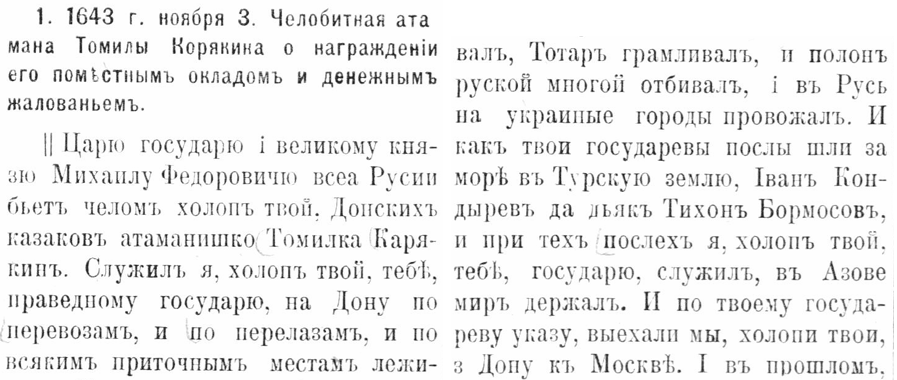
Original text (in Old Russian):
И нынѣ указалъ великій государь тѣхъ Донскихъ станичниковъ съ Москвы отпустить на Донъ;
а что имъ великого государя жалованья дати на отпускѣ, и о томъ, великій государь какъ укажетъ. И выписано имъ на примѣръ.
Въ прошломъ во 170-мъ году присыланы къ великому государю з Дону съ войсковою отпискою Донскіе станичники, атаманы Ѳролъ Минаевъ да ясаулъ Елистратъ Ивановъ, а съ ними казаковъ 4 человѣка; а великого государя жалованья дано имъ на отпускѣ: атаману сукно аглинское доброе, денегъ 10 рублевъ; || ясаулу сукно аглинское, денегъ 8 рублевъ; казакомъ по сукну анбурскому, денегъ по 7 рублевъ человѣку.
1661—1667 — Pacification of brigandage on the Volga and Yaik.
He pacified brigandage in the region. On August 8, 1660, Alexis Mikhailovich ordered imperial charters to be sent to the Don demanding the withdrawal of brigand Cossacks from the Volga and Yaik (brigandage harmed trade with Persia).
The Don Army, having heard the Sovereign's charter in the Krug (Circle), decided in 1661 to send Atamans Vasily Gladkov and Frol Minaev to the towns of the upper course and further on the Volga and Yaik. There is little data, but judging by the fact that massive Don Cossack brigandage on the Volga, Yaik, and the Caspian Sea ceased completely until 1667, their mission can be considered a success.
Archive text (in Old Russian)...
In 1667, a Tsar's decree was published on the beginning of the construction of ships for the Caspian military flotilla, some of which were burned by Stepan Razin.
Also during these years, the Don Cossacks, forcing passage through the Cossack Erik (channel to exit into the Sea of Azov), devastated Turkish and Crimean settlements and boarded their ships.
1668 — Diplomatic mission to Moscow and return to the Don.
In January, Ataman Frol Minaev was in Moscow with the Don stanichniks, at the Ambassadorial Prikaz. This is a documented fact that refutes versions of his participation in the beginning of Razin's Persian campaign (who was already on the Yaik at that time).
Returning to Cherkassk in the spring, Minaev, along with Army Ataman Kornila Yakovlev, dealt with the defense of the territory against Tatars and Turks. While the "golytba" (the poor) left for the Caspian, the starshina ("the skeleton of the Army", the elders) could not leave the Don undefended and remained for the defense of the towns.
1669 — Conflict with Stepan Razin.
In November, when Razin returned from the Persian campaign, Frol Minaev led an embassy from the Army to the rebels to clarify their intentions (rumors circulated that Razin wanted to kill the "best people").
The mission ended in a violent conflict. Razin threatened Minaev with execution ("wanted to put him in the water"), but eventually released him. This event marked the definitive rupture: Minaev represented the party of statists, and Razin began an open war against the order of Moscow and the Don.
1670 — Keeping the Don out of the revolt and confusion of names.
At the height of the Peasant War, Frol Minaev was on the Don and in Cherkassk. His main task was to dissuade the main part of the Don Army from participating in the anti-Moscow mutiny, which he succeeded in doing (jointly with K. Yakovlev).
Note: In some reports of Voivodes from this year (for example, on the capture of the city of Ostrogozhsk and the murder of the Voivode), the name "Frolka Minaev" is mentioned by mistake. Historical analysis has proven that this was an error by frightened clerks, confusing the famous Ataman Minaev with Stepan's brother — Frol Razin, who was actually acting in these regions. If Minaev had actually executed a Tsar's Voivode, he could not have continued his career as Ataman and diplomat.
Interesting fact: despite the enmity of the fathers, 20 years later, in 1690, the son of the executed Stepan — Afonka Razin — lived in Frol Minaev's house.
1672 — Cossack campaign under Azov.
In July, the Don Cossacks destroyed one of the Kalancha towers and later acted on 34 strugs near the coasts of Turkey.
The tower was later rebuilt by the Turks.
1672—1673 — Visit to the Tsar and plans for Azov.
Tsar Alexis Mikhailovich, intending to seize Azov and sending an army to Crimea, summoned Minaev to Moscow as a man "having been in Crimea and on the sea".
On December 26, Frol arrived at the Tsar's in Moscow. At the council held in Moscow, Frol Minaev declared to the Tsar and Boyars that the Army could provide 5000 elite Cossacks. If 8000 soldiers and Streltsy joined them, they would sow terror not only in Azov, but also in Istanbul, which would force the Turkish Sultan and the Crimean Khan to leave Poland and Ukraine alone and withdraw to defend their possessions.
Minaev's speech: "at that time... not only in Azov, but also in Constantinople the fear would be great".
This audience, where Minaev held a speech before the Tsar and Boyars, proposing a strategic war plan against Azov, could not happen without reason.
In the strict and hierarchical Muscovite state, only those who had proven their competence for years obtained the right to speak before the Duma.
This allows us to affirm: Alexis Mikhailovich knew Frol Minaev personally and for a long time.
Their contacts began no later than 1661, when Minaev brought crucial intelligence on the alliance of Crimea and Poland to Moscow.
Ten years before this reception, Frol already had access to the cabinets of power and undoubtedly had personal interviews with the Sovereign.
It is precisely this "credit of trust" accumulated over decades that allowed the Tsar in 1672 to listen to the Ataman's advice.
This is a striking example showing Frol Minaev not only as a cunning diplomat but as a geopolitical strategist,
who sees the world map much more broadly than an ordinary Cossack Ataman.
In 1672, Russia greatly feared a major war with Turkey over Ukraine (which finally took place — Chyhyryn campaigns). Moscow feared a direct clash of main forces.
What does Minaev do? He says: "You don't need to strike head-on. Let's strike from the rear (on Azov). This will distract the Sultan, and he will leave Poland and Ukraine to save his home."
He is not selling a "raid for booty," he is selling a strategic diversion.
The phrase "not only in Azov, but also in Constantinople the fear would be great" — is pure psychology.
He promises the Tsar not only to take a fortress but to frighten the very capital of the Ottoman Empire.
For Alexis Mikhailovich (the Quietest), this sounded like music — to become the Tsar who made Istanbul tremble.
Minaev talks about the fate of Poland, Ukraine, and Crimea. He operates with categories of interstate alliances.
This proves that he perfectly studied foreign policy during his "secret" travels and reconnaissance.
It was interesting diplomacy. Minaev manipulated the interests of a huge empire to achieve the cherished goal,
matured for a whole century — the destruction of the hated Azov, which was long one of the main trading points for captured Russians.
And although in 1672, cautious Moscow gave only partial support, the seed was sown.
25 years later, the son of this Tsar, Peter I, would realize the old dream of the Cossacks.
With the Tsar at the beginning of 1673, Minaev participated in the bear hunt and an artillery review.
Presence at the "entertainment with bears" and the cannon review is much more than an official reception.
The official reception (at the Palace of Facets) is work. The Tsar receives ambassadors, nods, clerks write. It's routine.
But shared leisure (bear hunting) is a sign of personal sympathy and entry into the "inner circle".
In the 17th century, bear entertainment was reserved for "one's own". Only the noblest Boyars and very important foreign ambassadors were invited.
By inviting the Don Ataman, Alexis Mikhailovich showed the court: "This man is very close to me in spirit".
There is also mention of a charter this same year: Charter to the Don Cossacks with a reprimand to Ataman Frol Minaev for indecent words.
What are "indecent words"? In documents of that time, this term hid:
*Refusal to execute a Voivode's order ("I won't go into that steppe, the horses are tired").
*Attack on honor ("You haven't smelled gunpowder, you sit in the chancellery").
*Political audacity ("We have our own orders on the Don, Moscow doesn't dictate how we choose Atamans").
It was a conflict of jurisdictions. The Voivode considered himself the chief of all, and the Ataman considered himself the equal of the Voivode (especially after the reception with the Tsar).
There was probably a conflict with Khitrovo, and the dispute was about tactics or supplies. Minaev, as an experienced military man, could have criticized the Voivode's plan brutally.
But there is another version: the reprimand charter of 1673 could be a calculated episode in Minaev's biography.
Returning from Moscow, where he had been noticed by the Tsar's attention for his hidden role in pacifying the revolt,
Frol found himself in a difficult position: in the Cossack environment, suspicions could arise regarding his excessive proximity to the capital's power.
To maintain the authority of an independent and resolute Ataman, he had to dispel these doubts.
In this context, a violent conflict with the Tsar's Voivode and the official reprimand from Moscow that followed, read before the entire Army,
could play an important role.
Having heard about the Ataman's tough reaction and the official sanction that followed,
the Cossacks saw in it a confirmation of his independent position.
Consequently, this demonstrative episode strengthened the Army's confidence and simultaneously allowed Minaev to maintain solid ties with central power.
Such a multi-move political tactic looks like a fine and farsighted calculation, fully corresponding to the realities of the 17th century.
1674 — Campaign under Azov and in Crimea.
Minaev's campaign under Azov and in Crimea with Voivode Ivan Savostyanovich Khitrovo and Stolniks Prince Ivan Andreyevich Tararuy Khovansky and Grigory Ivanovich Kossagov, with Ataman Yakovlev and starshinas Samarianin and Osipov.
Colonel Kossagov commanded a flotilla of Russian ships numbering 25 pennants, near the Taganrog Spit in the Sea of Azov; it attempted to bypass the nomadic Crimean Tatars by water, but a strong fleet of Turkish galleys was at Cape Kezagor, and Kossagov decided to turn back.
1675 — Campaign across the Putrid Sea.
Minaev with his 300 best Cossacks, joining the troops of Prince Kaspulat Cherkassky and the Zaporozhian Cossacks under the leadership of Ataman Ivan Sirko, where their large detachment "crossed the Arabat Spit, across the Putrid Sea (Sivash), took the camp with the tents and the bunchuk, and sustained a fierce fight with three Crimean sultans who were attacking him with superior forces".
The principles of relations between the Sich and the Don were set out, notably, in the Zaporozhian charter to the Don Army of 1685, in which "they, the Zaporozhians, wrote... about their advice and love,
so that river with river (that is, the Dnieper with the Don) have advice and love between them and keep each other informed of all business". According to Don Army Ataman Frol Minaev,
commenting on this message, "in previous years" the Don people "corresponded with them, the Zaporozhians, and held council, and were never in enmity with them, and kept each other informed of military affairs".
"And previously, — declared the Don people in 1651, — they, the Zaporozhian Cherkasses, with them, the Don Cossacks, were always in friendship and liaison and obtained booty together".
1676 — Pacification of local brigands.
Pacification of local brigands, as well as Old Believers arriving on the Don from the north because of Patriarch Nikon's persecution. The Old Believers always incited the Cossacks to march on Moscow, which Minaev prevented.
In Rigelman's book "History or Tale about the Don Cossacks" edition of 1778, there is information on the pacification of thieving Cossacks and their call to the Tsar's service.
The book mentions as Minaev's companion the Yaik Cossack Ataman Ivan Belousov.
On December 14, Minaev arrived in Moscow.
1677 — By decision of the Army Circle (Krug), it was decided to send horse and foot Cossacks to Ukraine, under the command of Field Ataman Mikhail Samarenin and Atamans Frol Minaev and Konan Kirilov.
1678 — Campaign in the service of Prince Romodanovsky.
Interrogation speech of Stanitsa Ataman Pyotr Evdokimov and Yesaul Ivan Fedorov on July 17, 1678 (In Moscow at the Ambassadorial Prikaz):
"... And from the Don they left, Great Sovereign, for service, to the Boyars and Voivodes, to Prince Grigory Grigoryevich Romodanovsky with his companions, at the beginning of Peter's Fast the first week, in foot order; their Ataman is Konan Kirilov, and with them 1000 Cossacks... And Ataman Mikhail Samarenin and Colonel Frol Minaev left the Don with a horse army, and with them 1000 men too, a week before their departure".
1679 — Election as Ataman of the Don Army. He held this post with interruptions for nearly 20 years.
1680 — Hesitations of the Army and missive to Moscow.
Tsar Feodor Alexeyevich sent a charter to the Don, calling on the Cossacks to join Prince Cherkassky. Having received the charter, Army Ataman Frol Minaev sent messengers to all Don towns, calling to go to Cherkassk for a general gathering.
The Cossacks gathered at the Main Army were undecided. They were ready to go on campaign to join Prince Kaspulat Cherkassky, but dared not do so. Because they feared that with the departure of the main Cossack forces, the Don towns would become defenseless against Crimeans and Nogais on one side, and Kalmyks on the other. Meeting in a Circle, the Cossacks decided not to leave the Army for the moment, and to send to Moscow a missive on Don affairs, informing the Sovereign of the preparations of the Azov people and the betrayal of the Kalmyks, with a light stanitsa of Ataman Alexey Naumov.
1681 — Diplomacy with Sein Pasha and restraining Cossack anger.
Ataman Frol Minaev, having learned of the raid by Azov people and Nogai Tatars, sent without delay several notable starshinas to Sein Pasha, demanding to stop the devastation of the Don and Russian ukraines (borderlands), and to return captured prisoners. to this, the Pasha answered insolently that if the Turkish Sultan and the Russian Tsar had concluded peace, he, Sein, did not care.
Having learned of such an insolent answer from Sein-bey, the Cossacks, meeting in a Circle, decided: "... not to sell or transport wood and coal to anyone openly or secretly (to Azov)". They also wanted to go immediately to wage war on Azov. However, Ataman Minaev, after long disputes, managed to convince the Don people not to violate the Sovereign's order and not to attract his anger and disgrace on the entire Army. The reason was that the Tsardom of Russia had just finished the war with the Ottoman Empire.
1682 — Oath to the Tsars and restraining looting campaigns.
On June 10, Stolnik Yanov arrived at the Main Army. At that time, many Cossacks led by Army Ataman Minaev were, according to the Sovereign's decree, on campaign. They were crushing Azov people, Crimeans, and Nogais in the region of the Tor summits, however, most of the steppe people managed to flee to Azov.
On July 8, Minaev has his army (of the Don) swear allegiance to Tsars Ivan and Peter.
The discontent of the Cossacks facing the Sovereign's prohibition to conduct campaigns under Azov and in Crimea reached its peak that winter. In many Don towns, both downstream and upstream, bands of daredevils appeared calling on the Cossacks to go get booty (zipuns) across the Volga in Persia or under Azov and in Crimea. However, Army Ataman Minaev succeeded in many cases in preventing these campaigns, acting both by persuasion and by threats of death penalty for disobedience to the Army and the Sovereign.
Moreover, all year, despite this, there were constant skirmishes of Don Cossacks with various enemies. On December 24, the winter stanitsa of Frol Minaev and Yesaul Ekim Filippov arrived in Moscow accompanied by 102 Cossacks, with a missive from the Army and a petition.
1683 — Correspondence with the Khan and Charter of the Tsars.
However, despite all threats and prohibitions, raids by Don people on warlike neighbors did not cease. Moreover, often, the initiators were the Cossacks of the Main Army.
A patrol of 60 Cossacks and 50 Kalmyks sent by Minaev suddenly passed Perekop, captured 800 horses in Crimea and brought them back to the Don. There were many more Cossack raids in Crimea, so much so that an irritated Murat-Girey sent a threatening charter to Minaev, to which there was also a similar response: "... and you yourself Khan Murat Girey, with a large army and a great gathering you will come to us by winter road on the ice: why go so deep? We are people of little wealth; we have few herds of horses and cattle; our towns are not profitable – woven of wattle, surrounded by thorns, and they must be taken with hard heads, for the cutting of which, as you know, we have strong hands, sharp sabres and accurate muskets. Spare your health: do not come".
The charter sent by Minaev to the Tsar regarding this message cites another text, a little more restrained, which can be read in the book "Collection of State Charters and Treaties" edition of 1826, page 471.
It is likely that this case of correspondence between the Don people and Murat-Girey is the true historical prototype of the situation that Repin depicted in the form of a beautiful legend. It is unlikely that the Turkish Sultan wrote personally to the Zaporozhians, and that they sent him a letter composed only of swear words — such correspondence at the level of the empire and "brigands" (as the Turks saw them) was not in accordance with protocol.
But with the Khans of Crimea, the Cossacks really communicated, and always responded to ultimatums with boldness. But this real case differs from the famous "letter of the Zaporozhians" in that there are no gross insults and rhymed insults. Instead, the text contains dignity, severe irony, and undisguised military threat.
At the end of the year, the Don Cossacks received a charter from the Tsars: "Atamans and Cossacks of the Don, Frol Minaev and the entire Don Army! The Great Sovereigns... favor you, Atamans and Cossacks, you Frol Minaev and the starshina, and the entire Don Army – have ordered to ask of your health and graciously praise your service".
That year the first information about medicines on the Don appeared, when the government
granted Army Ataman Frol Minaev "for his illness in medicines ten zolotniks of elixir proprietatis free of charge from the Apothecary Prikaz"
1684 — Attack by Azov people against fishermen.
Not limiting himself to the Circle's decision to forbid going into the service of the King of Poland, F. Minaev sent charters with a similar prohibition to all towns.
In late October, 50 Don Cossacks went fishing in the area of the Kalancha towers, towards the Cossack Erik, relying on the peace concluded with the Azov people. But they, seeing the carelessness of the Don people, attacked them: "... one hundred and fifty Azov Tatars attacked, and took these Cossacks and the nets, and killed others". Having learned this, Army Ataman Minaev took measures all year for the return of the Cossacks from captivity, and in Azov Bey Murtoza replied that it was not they who had taken the prisoners, but the Cossacks did not believe them.
Frol Minaev wrote to Moscow about the taxes that the Tsaritsyn Voivodes levied excessively on Don Cossacks arriving in Tsaritsyn.
1685 — Defense of Cherkassk and campaign towards Azov.
At Trinity, the Cossacks learned that on a raid "... this summer on Trinity Day, Agas with Turks and Tatars and Nogais and Cherkasses and with many people of war came out of Azov towards the Ukrainian towns of the Great Sovereigns and towards their upper Cossack towns".
Having learned this, Ataman Frol Minaev pursued them to the White Mountains. Some time later, the Turks wanted to approach Cherkassk by boat and take "tongues" (prisoners). However, the Cossacks, having noticed them, opened fire with cannons and drove the Turks back. Similarly, Ataman Minaev led a campaign towards Azov to help Cossacks attempting to cross to the Sea of Azov, but they had no success.
All year, Minaev exhorted the Tsar's government saying that they were undertaking no action against Azov, that it was very difficult to manage the Cossacks, because they were very angry with the Azov people.
1686 — Military actions against the Turks and fight against the schism.
Russia made peace with Poland and Tsarina Sophia sent a charter to the Don Cossacks calling to begin military actions against the Turks and Tatars.
Minaev, upon receipt of the Tsar's charter on the authorization to attack Azov again, gathered the Army and sent it to Azov, Lyutik, and other enemy towns, ensuring central command himself. The Azov people and Crimeans, not knowing the alliance concluded between Russia and Poland, considered the intensification of the Don Army's fighting as an arbitrary action. And so they were quite surprised when they learned of the appearance on their borders of Prince Kozlovsky's elite troops, while the garrison of Azov, after losses suffered that summer in fighting with the Cossacks, numbered a little more than 1500 men.
Within the Don Army, all these years, discord reigned, Old Believers (schismatics) pressured many Cossacks and wanted to separate from Moscow, but Minaev suppressed the schism by various means all these years.
Frol Minaev, accustomed to Kremlin court intrigues, did not trust conversations and rumors inciting Cossacks to a campaign on the Caspian Sea, and therefore asked Prince Golitsyn to inform the Army of the official position of the Moscow court, and to confirm this position in every sovereign charter.
On December 3, Frol Minaev arrived in Moscow.
1687 — Participation in the first Crimean campaign and fire in Cherkassk.
Participation in the first Crimean campaign of the Russian army under the command of Prince Golitsyn. Minaev commanded the land operation of the Don Cossacks, having once crushed a detachment of Crimean Tatars of 1000 men (500 horse Cossacks of Frol Minaev crushed the Crimeans in the steppes of the Black Sea). The naval operation of the Don Cossacks, having started successfully under the direction of Field Ataman Pyotr Kalmyk, suffered a defeat, Kalmyk was taken prisoner and executed in Azov.
That year also, there was a fire in the Cossack capital — Cherkassk, the city burned almost entirely, restored only 2 years later. But despite the fire, "And the next day after this fire, Army Ataman Frol Minaev and the colonel of their current stanitsa Ataman Kirey Matveyev... and with them about 2000 Cossacks... left for Azov the same day on horseback in the evening".
Minaev was meanwhile constantly between two fires — external enemies, where he had to lead battles, and internal schism, when someone constantly wanted to depose him, eliminate him from the Don or kill him.
1688 — Thanks from Peter I and interception of Tatars.
Minaev receives a Tsar's charter, in which "for faithful and zealous service" thanks were expressed from Tsar Peter I. There were also charters to send thieving people to Moscow. It was difficult for Minaev to counter internal Cossack quarrels and the schism.
In addition, that year, according to reports from Boyar Son Ilya Protopopov, Azov Turks and Crimean Tatars raided Russian ukraines, where they took booty and many prisoners. Having learned this, in August, Army Ataman Frol Minaev left with Cossacks to intercept them. The Don people managed to retake part of the prisoners, exterminate 100 Tatars and take 13 prisoners.
Excerpt from Patrick Gordon's diary of July 26 on this subject: "...Cossacks arrived from the Don reported .... 2000 of the Turkish garrison of Azov went out to raid the Tsar's lands;
Don Cossack Ataman Frol left with 2000 Cossacks to watch their actions."
On December 25, a sovereign charter was sent from Moscow to the Don: "... and you, Atamans and Cossacks, you Frol Minaev with your companions must be five hundred men..." to present themselves in the city of Novo Bogoroditsk.
1689 — Second Crimean campaign and defense of Cherkassk.
Minaev sent Cossacks by land and sea to participate in the second Crimean campaign of the Russian army under the command of Prince Golitsyn. The Cossacks crushed two detachments of Crimean Tatars on the land route and captured many Tatar and Turkish ships on the Sea of Azov.
The Cossacks did not let Minaev himself leave Cherkassk (Frol Minaev, by general verdict of the Circle, had to stay for the restoration of the Main Army and its defense), because they feared an attack on Cherkassk and wanted to leave a competent military leader for defense, and such attacks soon followed.
On December 13, Minaev arrived in Moscow.
1689—1694 — He commanded local battles with Tatars near Azov, Cherkassk (near which in 1692 a defeat was inflicted on the Azov people) and other nearby towns and places.
1690 — Local skirmishes, exchange of prisoners.
On May 6, a sovereign charter was sent to the Army, according to which Ataman Minaev and the Cossacks were to provide assistance in the exchange of prisoners.
Despite bitter fighting in the south, Don Cossacks were often believed on their word, sometimes releasing prisoner Cossacks in advance if there was no one for exchange.
In the summer of 1690, thieving Old Believer Cossacks, under the command of Levka Manytskov, gathered in a single detachment allied with Cherkasses,
Azov people, and Nogais numbering up to a thousand sabres and struck the Tor lakes in the border area of Little Russia, where a regiment of Sloboda Cossacks (from Izyum) and Russian settlers stood.
The Old Believers constantly worried Don towns and Russian "Ukrainian" towns with raids.
Later, in the 1690s, Don Atamans faithful to Moscow would conduct several punitive campaigns on the Kuma to destroy this hotbed of "schismatic Cossacks".
Finally, Levka Manytskov in 1695, during a new raid, apparently appeared with repentance in Cherkassk — and began to incite the Cossacks to revolt. He was seized and executed.
After the death of the daring Ataman, attacks by Old Believers began to weaken.
1691 — War with Kalmyks and Azov people, maritime searches.
Many towns were destroyed to their foundations and depopulated — the Don people repelled the Kalmyks and Old Believers with difficulty. The Kalmyk raid overflowed the cup of the Don Cossacks' patience. The Don people, no longer fearing Moscow and its disgrace, and the entire Army, from top to bottom, began to prepare for a campaign against the Kalmyks. By decision of the Circle, Cossack regiments were to be led by Army Ataman Frol Minaev. But after long relations, the Kalmyks concluded peace with the Don Cossacks on the Cossacks' terms.
However, this did not stop Ataman Minaev and the entire Army from decisive actions against the Azov people and Tatars. A naval army of Don people of 800 men was sent on maritime search. Another 200 well-mounted Cossacks carried out a raid under Perekop in June 1691, where breaking into the Tatar ulus at a place called Karakuy, they captured 35 Tatars, killing many others and taking numerous herds of cattle.
A second detachment of horse Cossacks was sent into the Nogai steppe, and "... on the Nogai side they also killed many Azov people and took ten prisoners".
The Kalmyks (Taishi Ayuka) violated the peace treaty anyway and having agreed with the Bey of Azov, left with him on a campaign against the Russian ukraines. The Don people managed to intercept the enemies "... not letting them reach the Ukrainian towns, crushed them and killed many, and took some as 'tongues'".
1692 — Maritime battles and defeat of Azov people at the crossing.
In September, for reconnaissance and capture of tongues, Ataman Minaev sent 15 more strugs to sea: "... in September on these same dates, we, your servants, sent a second time by sea on 15 of our barques our Cossacks...". But the Turks, having numerical superiority, managed to defend themselves and break through to Azov. The Cossacks landed at the Azov suburbs and attacked them.
In October 1692, Azov people, having joined a small detachment of thieving Kalmyks, totaling 100 men, went to the baranta (cattle theft). At night, having approached Cherkassk stealthily, they took 200 horses grazing near it and the town of Manytch.
This success incited the Azov Turks to carry out a larger raid. Aga Kubek with 500 Azov people and Kalmyks of Ayuka, took 1500 horses from the Vasilyeva river by night, driving them towards Azov. Surviving shepherds signaled the theft of the herds to Cherkassk and the town Monastyrsky. And soon 1000 Cossacks set off in pursuit of the looters. Ataman Minaev sent part of the Cossacks to the crossing, on the Aksay river, where the Azov people and Kalmyks had to ford the river to the Azov side.
The calculation proved correct, and the Don people caught up with their enemies during their river crossing. The Azov people and Kalmyks were overthrown and put to flight. However, there was nowhere to flee, the ford was surrounded by muddy swamps, where many fugitives drowned. The Cossacks retook not only all their horses, but also captured 300 enemy horses, with saddles and harnesses. Almost the entire detachment that left Azov for the baranta was annihilated.
1693 — On March 2, Army Ataman Frol Minaev is ordered to send 10 more "pipes" not sent for the construction of maritime strugs. Also in the charter, the Cossacks were called to "Guard against raids by Kalmyk Khan Ayuka Taishi".
On December 12, Minaev's arrival in Moscow.
1694 — In 1694, Ivan Semyonov was elected Army Ataman, elected more than once to this post. However, in October, Frol Minaev was already mentioned as Army Ataman.
1695 — Repelling Azov reconnaissance and sending a standard to the Don people.
At the beginning of the year, Minaev dispersed a detachment of up to 3000 Azov people under Cherkassk, who, on rumors of a Russian attack against them, had gone out on reconnaissance.
February 12: By decree of the Great Sovereigns, before the Azov campaign, a standard was sent to the Don to Army Ataman Frol Minaev and to the entire
Don Army. The center in white taffeta, the border in red taffeta, on it is painted in gold the double-headed eagle.
1695 — First Azov campaign of Peter I.
By decree of Peter I of March 16, 1695, Army Ataman Minaev was ordered to prepare a thousand horse carts. By the Sovereign's charter, the entire Don Army was instructed to be ready for the campaign and, as regular regiments arrived in the towns, to march with them and go to Cherkassk. In addition, the Don Army was ordered to place ambushes and patrols on all roads leading to Azov.
Executing the Tsar's order, Frol Minaev sent 150 men on the Astrakhan roads as early as March 1, and 300 men into the Crimean steppe, for setting up ambushes and guards. However, it was not possible to keep secret the information on the Russian army on the march.
7000 Cossacks of Army Ataman Frol Minaev joined the Russian army. Minaev's Cossacks captured the two towers (kalanchas) that prevented the Russian fleet from exiting into the Sea of Azov (between them were stretched three rows of chains mixed with logs, and cannons were on the towers). The capture of the towers boosted the morale of the Russian army, which had fallen following numerous failures during the siege.
Minaev also begged the Tsar to attack the Azov fortress; they broke onto the fortress rampart, but were not supported and retreated. Even after the retreat of the Russian army in 1695, the Cossacks guarded the kalanchas, repelling Turkish assaults.
Details of the capture of the kalanchas are described in Patrick Gordon's diary:
July 11: ...We deliberated to attempt to capture the nearest Kalancha tower, for which the Cossacks volunteered. Thus, 2000 rubles were promised to 200 men...
July 14: One hour before dawn, our
Cossacks, supported by a regiment of soldiers, suddenly attacked
the nearest Kalancha tower. As the petard had
no effect on the iron gates, the Cossacks pierced with hoes
a wide passage near one of the cannon loopholes, through
which they entered. [The Turks] fired from inside
and threw stones, and also fired cannons from the other tower,
which lasted about an hour. Finally, having locked themselves in their
quarters, they were forced to surrender. Some threw themselves into the
river and drowned, only one escaped. 15 prisoners were taken and
15 cannons of different sizes, some barrels of powder and
munitions, but almost no food.
July 16: By night, the Turks abandoned the other fort on the Kalancha,
which our Cossacks noticed in the morning and occupied it; here were
taken 20 cannons, some booty and munitions, but
few provisions. Hence great joy.
After the failure of the general assault of September 25, 1695, Peter I was definitively convinced that without the support of a powerful fleet, he would not take Azov.
The Tsar lifted the siege, and saying goodbye to the Ataman before leaving for Moscow, Peter said to Minaev: "Guard, Minaich, these kalancha towers and wait for me with the ships in Cherkassk in the spring.
I swear before God – Azov will be Russian!"
1696 — Second Azov campaign of Peter I. Capture of Azov. "Cossack Admiral".
Participation in the second victorious Azov campaign. Besides managing his Cossacks on land, Minaev commanded the Cossack flotilla which crushed the Turkish fleet, receiving the nickname "Cossack Admiral" from Peter the Great.
This was the very first naval victory under the reign of Peter the Great, as well as the first land victory — the capture of Azov that followed, as assumed in 1855 in the Military Encyclopedic Manual — Lexicon.
The fate of Azov was decided by the Don and Zaporozhian Cossacks, weary of its slow siege.
Moreover, towards mid-July, they began to run out of food. Meeting in council, the Atamans and Cossacks led by Frol Minaev and Yakov Lizogub,
decided to take the Turkish fortress themselves. On July 17, up to 2000 Cossacks, quickly and unexpectedly climbing onto the earthen rampart, drove the Turks from it and penetrated inside the fortress.
History of the Reign of Peter the Great Volume 2 edition of 1858 page 288:
The indomitable courage of the Cossacks accelerated the fall of Azov.
Bored with the long siege, and even more with the heavy work during the erection of the rampart, and already feeling the lack of food,
the Zaporozhians agreed with the Don people to strike Azov, in the hope of enticing the other troops by their example.
Their valiant leaders, acting Hetman Lizogub, "a man skilled in virtue and military labors"
and Army Ataman Flor Miniaev, led themselves up to 2000 braves to the assault.
The Cossacks quickly climbed the earthen rampart, overthrew the Turks standing there,
descended inside the fortress and, briskly pursuing the enemy stunned by the unexpected attack,
almost broke in behind him into the stone castle. The Turks repelled them with cruel musketry fire,
shooting, for lack of lead, cut silver pieces. If at that moment the other troops had moved,
Azov would have been ours. But the soldiers and Streltsy did not move from the camp, and the Cossacks, not seeing the possibility of maintaining themselves in the fortress,
returned to the rampart, where they established themselves in the corner bastion.
The Cossacks almost broke in on the heels of the retreating enemy into the stone citadel of the fortress.
On July 19, the fortress of Azov surrendered, on July 20 the fortress Lyutik also surrendered.
In Gordon's diary, there is much information on the defeat of the Turkish fleet
(as well as in the book History of the Reign of Peter the Great Volume 2 edition of 1858 pp. 273-276, the sources complement each other). Basically, it happened like this:
On May 19, 2 Turkish ships stood on the roadstead and Peter the Great discussed attacking them:
On the river I met His Majesty and
I went with him to the fort, then on my boat, where with Boyar Fedor
Alekseyevich and the Don Ataman we discussed His
Majesty's project to attack these 2 ships, standing on the roadstead downstream from Azov, on
the lake. We concluded that His Majesty with his galleys and the Ataman with
the Cossacks would go attack them...
In the evening, the Cossacks on about 40 barques (about 20 men on
each) went down the river, and His Majesty followed with 9 galleys
and one of my infantry regiments.
May 21, Thursday. Around 10 o'clock, His Majesty arrived at my place
and told how he had been at sea and had seen about 20 sailing galleys
and ships and many light vessels; he found it
inconvenient to venture against them and ordered the galleys to return —
he was
very melancholy and dejected.
At 3 o'clock in the afternoon His Majesty arrived at my place and announced the good
news: how the Cossacks yesterday evening had attacked the Turkish fleet, broken it
and dispersed it; they killed some, took 27 prisoners with
much booty...
May 22, Fri. Rowing all night, although slowly, at dawn
I arrived at the mouth of the Kalancha river, where near the island I discovered the stationing of His
Majesty with the Cossacks. I put myself with my boats on the other side, and
then I went down to the island, where the Cossacks were sharing the booty.
In the history of the Azov campaigns, the role of the Don Cossacks (precisely under the direction of Frol Minaev, which is evident from Patrick Gordon's diaries) is not simply "important", it is decisive.
If one removes the Cossacks from the equation of 1695 and 1696, Peter I would most likely have suffered a crushing defeat and could have lost the throne at the beginning of his reign.
1695 — almost total failure of the army and success of the Cossacks — capture by them of the kalanchas.
1696 — the Cossacks did all the dirty work (like all the 90s of the 17th century in the Azov region): victorious battle on the water and final assault.
Peter is a figure-symbol. In history, it is customary to attribute victory to the head of state. We say "Napoleon took Berlin" or "Alexander the Great conquered Persia", forgetting the concrete generals and soldiers.
For imperial historiography, the Cossacks were often considered an auxiliary force, "cannon fodder" or reconnaissance.
Admitting that they surpassed the 1696 model regular army tactically and in fighting spirit was ideologically incorrect both in the Russian Empire and in the USSR
(where Peter was glorified as a progressive figure).
Azov was taken by Frol Minaev and his Don people, with fire support and blockade organized by Peter. But in history, this entered as the "Triumph of Peter the Great".
Peter I himself perfectly understood to whom he owed this, and respected Frol Minaev enormously personally — and there are confirmations of this in historical sources.
Soviet and imperial historians decided: the figure of the loyal but independent Ataman is too complex. Simpler to leave Razin (as a fighter) and Peter (as a victor),
and relegate the "boring" diplomat Minaev, who defended Russia's southern borders for almost half a century, to the background.
About the Cossack flotilla and the moment of the Cossack attack at sea, as well as the heroic attack of the Cossacks on the fortress, it is written in Rigelman's book "History or Tale about the Don Cossacks" of 1778.
On December 14, arrival of Minaev in Moscow.
Entry in Patrick Gordon's diary indicating that Peter was at the feast in Minaev's house (in 1695 and 1696).
1697 — Salary to the Cossacks and small skirmishes in the south.
At the beginning of the year, Minaev was in Moscow at Peter the Great's. Peter sent a charter to the Cossacks "... expressing praise to the Cossacks for having incited the Murzas of the Kuban horde to accept Russian subjection, for the action against Nogai uluses, under Temryuk and other places and for the provision of news on Ayuka Taishi and the Crimean sultans Nuradyn and Kalga; on the sending of salary to the Cossacks and on the provision of their share of help, for defense against the enemies of Azov, Sergeyev, the Kalanchas, and Lyutik".
Minaev asked Peter to help with paper and muskets "... have mercy on us, your servants, order, Sovereign, to give us your Great Sovereign's salary, muskets against your Great Sovereign's previous decree, and for all necessary business, paper to write on the Don to us your servants, what God will indicate to you, Great Sovereign".
Besides that, Ataman Minaev asked the Sovereign to gratify the Army with wood, iron, anchors, sails and other things for maritime strugs. All this was satisfied, except the muskets, instead of which money was given for their purchase.
On February 7, Peter gratified the Cossacks for the Azov service: Ataman Frol Minaev – with a velvet caftan on sable fur worth one hundred and fifty rubles.
There were also small skirmishes of Cossacks with Nogais, Crimeans, and Turks.
1698 — Small skirmishes in the south.
The winter of 1698 was particularly harsh and long. The Cossacks, because of active military actions against Turks, Nogais, and Crimeans,
had not had time to prepare enough fodder, which caused a great loss of cattle and horses.
With the arrival of spring, the Don people, despite the difficult winter, began active military actions. By general verdict of the Circle, Army Ataman Minaev
sent several hundred Cossacks on maritime search. They devastated the surroundings of the towns of Taman, Temryuk, and Kizyltash, after which they headed towards the Crimean coasts,
but did not have much success there. Besides that, despite the lack of horses, the Army sent 300 horse Cossacks on campaign against Crimean uluses:
"... only now at your place because of the winter cold and for lack of fodder, the herds of horses have perished, and those that remained in small numbers, and on those army Cossacks and
Kalmyks are sent on horseback numbering three hundred under the Crimean habitations".
This same spring, by decree of the Sovereign, the Army sent 1000 Cossacks for the relief of Cossack regiments guarding captured Turkish fortresses located on the Dnieper.
The Don people were led by Field Ataman Akim Filippyev.
1698–1699 — Receipt of charters from the Tsar with thanks for the defeat of Crimean and Kuban Tatars, "marching on Russian Ukraines and Kubanians on the Kuban river".
1699 — Embassy to Istanbul.
In April, at the end of the solemn meeting, the Tsar's dignitaries and the officers accompanying them went to the cathedral church of Cherkassk for a service (moleben).
After the service, they went to Army Ataman Frol Minaev, where they handed him the Sovereign's charter. Peter I ordered the Army to
conduct the ambassadors with honor out of Cherkassk and accompany them to Istanbul.
From the Main Army, the ambassadors, accompanied by the Cossack flotilla, left for Azov, and from there for Taganrog, where a ship of the line of 46 cannons
(40 cannons according to Bronevsky), 9 frigates, 2 galleys, a yacht, 2 galiots, 3 brigantines, as well as 4 large Cossack strugs awaited them,
with 500 Cossacks, led by Ataman Frol Minaev. The historian Bronevsky gives other figures: "... composed of 10 ships,
2 galleys, 6 galiots, 1 yacht and 6 Don barques, left to sea".
Upon arrival in Istanbul on August 28, the Russian ambassadors, Ukraintsev and Cheredov, having handed the Sovereign's charter to the Sultan, proposed to the Turks to conclude a peace treaty,
according to which Azov and the surrounding lands returned to Russia. But this did not suit the proud Ottomans at all. Long and difficult negotiations began, which,
finally, ended with the signing of the peace treaty on Russian terms.
There are testimonies according to which Frol Minaev, returned "in the autumns" from Istanbul (Constantinople), having arrived in the city of Cherkassk,
took monastic tonsure under the name of Philaret and, due to the absence of a monastery on the Low Lands (there is information on a disagreement of Minaev with Peter the Great regarding the fact
that several monasteries had been taken away from the Cossacks),
remained in monastic rank in his own courtyard, at his sons' home.
1700 — Death. Buried in Cherkassk (today stanitsa Starocherkasskaya). New 18th Century.
For Russia, the 18th century began with a difficult war with strong and aggressive Sweden,
whose king was the young, energetic, and talented commander Charles XII.
The Great Northern War began, in which the Don Cossacks participated, already without Frol Minaev,
but under the command of one of his sons — Maxim Frolov. The Cossacks performed outpost, reconnaissance, and guard duties.
During the Battle of Narva in November 1700, unfortunate for the Russians, the Swedes took many prisoners,
including about two dozen Don Cossacks, who never returned to the banks of the dear Don.
And a little later, in 1736, ended the battle of almost two centuries for Azov, in which another son of Minaev took part - Ivan Frolov.
The chronology does not mention the almost constant land and sea skirmishes of the Cossacks, the defense of towns and stanitsas against raids by enemies and brigands.